Tuesday, April 23, 2013

Proper Prayerful Worship: A Desire to See God's Will Fulfilled (Part 3)


“I pray that the eyes of your heat may be enlightened, so that you will know what is the hope of his calling, what are the riches of the glory of His inheritance in the saints, and what is the surpassing greatness of His power toward us who believe.” – Ephesians 1:18-19 (Context)

We have been focusing on prayer as a purposeful focus on God: His will; His grace; His plans; and His forgiveness. As a Christian, I must be biblically informed in order that my prayers are in “harmony with the will of God” (JM). I want God's will because God's will and counsel is good, wise, and perfect according Him – but don’t miss that God’s countenance is perfect for us, always . This kind of conscious, Spirit enlightened expression communicates "our praise, our unworthiness, our desire to see God's will fulfilled, and our utter dependence on Him for all our needs" (ibid). Thus, our prayer is worshipful.
In his book, “Knowing God,” J.I. Packer poses that the problem of knowing God is that most people, even Christians, do not think highly of – or fear – God. Do you think highly of God (Isaiah 5,6)? The God-ward focus of Jesus’ model prayer is impossible to miss with His opening lines establishing the focal point of non-repetitive, intimate, worshipful prayer. Jesus starts the prayer praising God’s name, expressing active willingness for His Kingdom to come and His will to be done (Matthew 6:7-14).  The supplicant is concerned for the honor of God and the extension of His Kingdom. Everything else fits into that context, so that the whole agenda of prayer is determined by the Kingdom and glory of God. This is perhaps the most important perspective to keep in mind in all our praying.

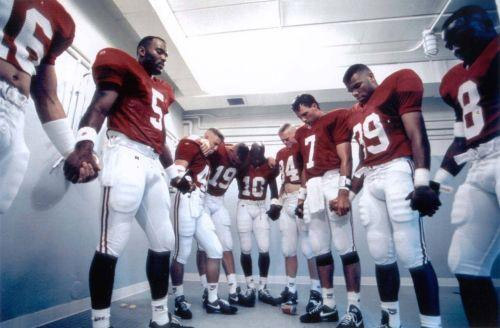
Alabama Christian Athletes Praying
            Far from being merely a wish list, godly prayer is fundamentally an act of acknowledging God’s sovereignty, confessing our own total reliance on His grace and power, and looking to him as Lord and Provider and Ruler of the universe. God is not some celestial Santa. Any prayers that are self consuming, self indulgent, self aggrandizing; any prayer that seek whatever I want no mater what God wants; any prayer that suggest God must deliver because I have demanded it – those are prayers that take his name in vain. Such praying is egregious sin against the nature of God, against the will of God, and against the Word of God. Because such prayer is an act of worship, to offer a prayer based on such a heinous perversion of God’s character is tantamount to worshiping a false god.

Source: Pulpit Magazine, Premier Issue. Oct 2012. Vol. 1 No. 1. Ipad version.

Monday, April 15, 2013

"Perhaps the Most Christian Human Being"

by Huffington Post's Jim Wallis

I just learned about Gordon Cosby who was a prolific and catalytic Southern Baptist pastor in D.C. During the days of segregation in America Cosby's ministry advanced interracial Sundays in D.C. - a practice which would arguably shape the vocations of so many pastors, more than any other figure in his generation (NPR). Cosby is not very famous but this amazing national tribute to his lasting endeavors provides for some really good legacy meditation. I sure hope some of these characteristics can be ascribed of me at my funeral.

“World War to Spiritual War”
After he graduated from seminary, the country was entering the war, so Cosby enlisted as a chaplain. Cosby was part of the invasion of Normandy on D-Day. He helped pull wounded soldiers to safety and ministered to the dying. For his service he earned a Silver Star for bravery.

"At Normandy, he buried hundreds of young men, including his best friend," says Wes Granberg-Michaelson, who knew Cosby for 45 years.

"As he dealt with young men who were facing death, he realized how poorly equipped they were to deal with the questions of life and death and how poor their faith had prepared them," Granberg-Michaelson says. "And it was that experience that convinced him to — if he survived the war — come back to the states and he would start a church that would have the ability to form faith deeply."

After his return in 1946, he did just that. The Church of the Saviour was one of the first places of interracial worship in the city. One of the tenets of membership in the church was a commitment to service in the community. Members were required to work with the homeless at shelters and at the church-run hospice and medical clinic.

“Could have been Famous but the Church was Most Important”
As his reputation grew, Cosby got invitations to speak from all across the country. He turned them all down; Cosby wanted his church to remain small. "What Gordon understood is that the model of church that he was setting forth — it wasn't going to survive if the church simply got larger and larger and larger," Granberg-Michaelson says. Gordon Cosby never needed or wanted to be out front or become a famous public figure. He could have spoken across the country, and was often invited to do so. But he instead decided that his own vocation was to stay with a relatively small group of people trying to "be the church" in Washington, D.C.: the Church of the Savior, which has produced more missions and ministries, especially with the poor, than any church I know of anywhere in the country -- even the huge mega-churches who capture all the fame. He never wrote a book, went on television, talked to presidents, planted more churches, built national movements, or traveled around the world. He just inspired everybody else to do all those things and much more. And the world came to him.

“How to live the Gospel and Love like Christ”
“Gordon Cosby taught us how to live by the Gospel and, in these last years and months, he also showed us how to die,” says Jim Wallis. In one of my many visits near the end of his life, Gordon said to me in his deep graveling voice, "I am enjoying dying." What a Gospel thing to say. From the first time I heard Gordon preach, to the last sermon he did a few years ago, I have never heard the Gospel and its meaning more clearly articulated than from Gordon Cosby. As one person said last night, "You knew he loved like Christ, and he made you want to love like Christ too."

“Holy Unrest: Thriving After Death”
Brian McLaren, an author and former evangelical pastor, says that while many evangelical churches don't often survive the death of their founders, Cosby's work is a living testament. "The deeper and broader legacy will be his indirect legacy on the people who were captivated by his holy unrest," McLaren says. "That he just could never be satisfied that the church was fulfilling its potential and that the Christian faith was fulfilling its potential."

Source:
1. Huffington Post: http://www.huffingtonpost.com/jim-wallis/gordon-cosby-teaching-us_b_2925125.html?utm_hp_ref=religion
2. NPR: http://www.npr.org/2013/04/14/177218091/pastor-mentor-and-social-activist-remembering-gordon-cosby

Saturday, April 13, 2013

The Power of Worshipful Prayer (Part 2)

By John MacArthur


When we properly make our requests known to God – without anxiety,
through prayer and supplication, and with thanksgiving (Philippians 4:6)
 – we are acknowledging His sovereignty, confessing our own total reliance
on His grace and power, and looking to Him as Lord and Provider
and Ruler of the universe – not as some kind of celestial Santa.
Leading into this next installment on prayer, we are becoming more intimately acquainted with the power and succinctness of prayer through the examinations of John MacArthur. He describes the joy of praying as "the distilled essence of worship." The problem of the misunderstanding of prayer is examined in the first article adopted from Pulpit Magazine's first issue. Particularly examined is how many Christians view prayer as nothing more than "a kind of utilitarian wish list." Unfortunately many stop there and miss out on the unmistakable "parallelism between prayer and worship (5)." This is no coincidence.  Diving deeper we examine how to have closer and lasting fellowship with the Lord God, Jesus, and The Holy Spirit through praying.

There are several problems with the perspective of prayer as exclusively asking. Prayer is more than merely asking. First, Jesus' model prayer is more than merely "asking." Don't misunderstand, prayer does include asking: there are petitions for daily bread (the bare necessities) and forgiveness (the most urgent of spiritual needs). But the model prayer Jesus gave His disciples also includes at least four of the five elements. There are many who want to eliminate from their definition of prayer: praise, adoration, humiliation, and confession.

Remove praise and penitence form the Lord's Prayer and you have gutted it. Insist that proper prayer "is not anything else but asking," and you overthrow one of the central lessons we learn from Jesus' example, that prayer is first and foremost an act of worship. Even worse, such teaching sets up a kind of role reversal between the one praying and the God to whom they pray.

Contrary to what the Bible teaches about our role and bondservant-relationship with the Lord, so-called “Name-it-and-claim-it” theology teaches that man is sovereign and God is his servant. The person praying thinks they are in the demand-and-command position, with God in the role of the servant who is obligated to cough up whatever we ask for. This sort of thinking has more to do with pagan cargo cults than with biblical Christianity.

Prayer is much more than merely asking and receiving. It is indeed a great privilege to come boldly before the throne of grace and to let our requests be made known to God (Hebrew 4:16; Philippians 4:6).  Scripture repeatedly promises that if we ask for anything in faith, God will answer – meaning if we ask in accord with God’s will as prompted by His Spirit (which we shall commune with actively in daily dialogue), He will always graciously and generously respond, not necessarily give (Matthew 7:7-11; 17:20; 21:22; Mark 11:24; James 1:6; 1John 3:22). He often grants our requests “far more abundantly beyond all that we ask or think, according to the power that works within us (Ephesians 3:20, NASB).


Godly prayer is fundamentally an act of worship.
But the nature of a genuine, faithful prayer is clearly spelled out in 1John 5:14: “This is the confidence which we have before Him, that, if we ask anything according to His will, He hears us.” In other words, the promise of answered prayer is not an unqualified blank check. The promise is made only to faithful, obedient, sober-minded, biblically informed Christians whose prayers are in harmony with the will of God. It’s not a guarantee of cargo to every gullible or superstitious religious enthusiast who uses Jesus’ name as an abracadabra. Jesus said, “If you abide in Me, and My words abide in you, ask whatever you wish, and it will be done for you” (John 15:7, emphasis added). The essential element in prayer is tied to Jesus assertion here. Godly prayer is fundamentally an act of worship. It is an expression of our praise, our unworthiness, our desire to see God’s will fulfilled, and our utter dependence on Him for all our needs. Thus every aspect of prayer is an act of worship.

When we properly make our requests known to God – without anxiety, through prayer and supplication, and with thanksgiving (Philippians 4:6) – we are acknowledging His sovereignty, confessing our own total reliance on His grace and power, and looking to Him as Lord and Provider and Ruler of the universe – not as some kind of celestial Santa. Proper prayer is pure worship, even when we are making requests.

Source: Pulpit Magazine, Premier Issue. Oct 2012. Vol. 1 No. 1. Ipad version.


Sunday, March 17, 2013

Brothers, God is The Gospel


The ultimate end of the gospel is coming home to God, implores John Piper.

God is the gospel.

The point of that simple sentence is that the highest, best, and final good in the good news is God himself.

In no way do I want to diminish what has traditionally and biblically been called “the gospel” —I just want to make sure we tell the whole story. So here’s my summary of Jesus’ gospel in six steps. These are all essential. If any one of them were to be removed, there would be no gospel.

1. THE GOSPEL IS A PLAN
The gospel originated in the mind of God. It was his plan before the foundation of the world.  (Genesis 3)

2. THE GOSPEL IS AN EVENT
The gospel is an event in history. It really happened. If there was no historical Jesus, and if he did not die and rise from the dead, there would be no gospel. (Matthew – Acts)

3. THE GOSPEL IS AN ACHIEVEMENT
In dying, Jesus absorbed the wrath of God. (2Corinthians 5:21)

4. THE GOSPEL IS A FREE OFFER
The good news would vanish if all that “achievement” on the cross were available only by the performance of sufficient good deeds. Therefore, an essential part of the gospel is that this news is proclaimed to all and offered freely to whoever will have faith in Jesus. (Ephesians 2)

5. THE GOSPEL IS AN APPLICATION OF CHRIST’S ACHIEVEMENT TO THE WORLD
The fundamental way all the achievements of Christ become ours is by union with Christ. This is why the tiny phrase “in Christ” is so prevalent in the New Testament.
Now this is where the gospel message usually ends. Plan. Event. Achievement. Free offer. Application. And, of course, this is a glorious ending, but there is still a sixth and final step. (Ephesians 1; 2Corinthians 5:17)

6. THE BEST AND FINAL GOOD
I return to my question: What is the highest and best and final good in the good news?

Second Corinthians 4:4 and 6 (below, emphasis mine) tell us the answer: the glory of God in the face of Christ, or, the glory of Christ who is the image of God.
In their case [the case of those who are perishing] the god of this world [that’s Satan] has blinded the minds of the unbelievers, to keep them from seeing the light of the gospel of the glory of Christ, who is the image of God. . . . For God, who said, “Let light shine out of darkness,” has shone in our hearts to give the light of the knowledge of the glory of God in the face of Jesus Christ.

This is a real glory, a real spiritual light that shines through the gospel from Christ in his saving work and is seen not with the physical eyes but with the eyes of the heart (Eph. 1:17–18).

Brothers, this is what I think our people need to hear over and over: forgiveness and justification and eternal life are good for one ultimate reason—they bring us to God himself.

The ultimate end of the gospel is coming home to God. Knowing him. Seeing him unsullied with our own sin. Enjoying him with the capacities for joy that heaven alone will give. “In your presence there is fullness of joy; at your right hand are pleasures forevermore” (Ps. 16:11).

Brothers, God is the gospel. What a difference it makes in a church when the people know this and embrace it with all their hearts!

Source: http://theresurgence.com/2013/03/10/brothers-god-is-the-gospel

Saturday, February 9, 2013

Representing Christ: Practical Lessons in Evangelism from Chick-fil-A


"Or do you think lightly of the riches of His kindness and tolerance and patience, not knowing that the kindness of God leads you to repentance?" - Ro 2:4

"Behold then the kindness and severity of God; to those who fell, severity, but to you, God's kindness, if you continue in His kindness; otherwise you also will be cut off." - Ro 11:22

"Throughout the conversations Dan expressed a sincere interest in my life, wanting to get to know me on a personal level. He wanted to know about where I grew up, my faith, my family, even my husband, Tommy. In return, I learned about his wife and kids and gained an appreciation for his devout belief in Jesus Christ and his commitment to being "a follower of Christ" more than a "Christian." Dan expressed regret and genuine sadness when he heard of people being treated unkindly in the name of Chick-fil-a -- but he offered no apologies for his genuine beliefs about marriage."  


Shane Windemeyer (L), founder and executive director
of 
Campus Pride, the leading national organization
for lesbian, gay, bisexual, transgender (LGBT)and all
college students, with Dan Cathy (R), Chick-fil-A
president and COO.
I spent New Year's Eve at the red-blooded, all-American epicenter of college football: at the Chick-fil-A Bowl, next to Dan Cathy, as his personal guest. It was among the most unexpected moments of my life.

Yes, after months of personal phone calls, text messages and in-person meetings, I am coming out in a new way, as a friend of Chick-fil-A's president and COO, Dan Cathy, and I am nervous about it. I have come to know him and Chick-fil-A in ways that I would not have thought possible when I first started hearing from LGBT students about their concerns over the chicken chain's giving practices.

For many this news of friendship might be shocking. After all, I am an out, 40-year-old gay man and alifelong activist for equality. I am also the founder and executive director of Campus Pride, the leading national organization for lesbian, gay, bisexual, transgender (LGBT) and ally college students. Just seven months ago our organization advanced a national campaign against Chick-fil-A for the millions of dollars it donated to anti-LGBT organizations and divisive political groups that work each day to harm hardworking LGBT young people, adults and our families. I have spent quite some time being angry at and deeply distrustful of Dan Cathy and Chick-fil-A. If he had his way, my husband of 18 years and I would never be legally married.

Why was I now standing next to him at one of the most popular football showdowns? How could I dare think to have a relationship with a man and a company that have advocated against who I am; who would take apart my family in the name of "traditional marriage"; whose voice and views represented exactly the opposite of those of the students for whom I advocate every day? Dan is the problem, and Chick-fil-A is the enemy, right?

Like most LGBT people, I was provoked by Dan's public opposition to marriage equality and his company's problematic giving history. I had the background and history on him, so I thought, and had my own preconceived notions about who he was. I knew this character. No way did he know me. That was my view. But it was flawed.
For nearly a decade now, my organization, Campus Pride, has been on the ground with student leaders protesting Chick-fil-A at campuses across the country. I had researched Chick-fil-A's nearly $5 million in funding, given since 2003, to anti-LGBT groups. And the whole nation was aware that Dan was "guilty as charged" in his support of a "biblical definition" of marriage. What more was there to know?

On Aug. 10, 2012, in the heat of the controversy, I got a surprise call from Dan Cathy. He had gotten my cell phone number from a mutual business contact serving campus groups. I took the call with great caution. He was going to tear me apart, right? Give me a piece of his mind? Turn his lawyers on me?

The first call lasted over an hour, and the private conversation led to more calls the next week and the week after. Dan Cathy knew how to text, and he would reach out to me as new questions came to his mind. This was not going to be a typical turn of events.

His questions and a series of deeper conversations ultimately led to a number of in-person meetings with Dan and representatives from Chick-fil-A. He had never before had such dialogue with any member of the LGBT community. It was awkward at times but always genuine and kind.

It is not often that people with deeply held and completely opposing viewpoints actually risk sitting down and listening to one another. We see this failure to listen and learn in our government, in our communities and in our own families. Dan Cathy and I would, together, try to do better than each of us had experienced before.
Never once did Dan or anyone from Chick-fil-A ask for Campus Pride to stop protesting Chick-fil-A. On the contrary, Dan listened intently to our concerns and the real-life accounts from youth about the negative impact that Chick-fil-A was having on campus climate and safety at colleges across the country. He was concerned about an incident last fall where a fraternity was tabling next to the Chick-fil-A restaurant on campus. Whenever an out gay student on campus would walk past the table, the fraternity would chant, "We love Chick-fil-A," and then shout anti-gay slurs at the student. Dan sought first to understand, not to be understood. He confessed that he had been naïve to the issues at hand and the unintended impact of his company's actions.

Chick-fil-A also provided access to internal documents related to the funding of anti-LGBT groups and asked questions about our concerns related to this funding. An internal document, titled "Who We Are," expressed Chick-fil-A's values, which included their commitment "to treat every person with honor, dignity and respect," including LGBT people. Dan and his family members had personally drafted, refined and approved the document.
Through all this, Dan and I shared respectful, enduring communication and built trust. His demeanor has always been one of kindness and openness. Even when I continued to directly question his public actions and the funding decisions, Dan embraced the opportunity to have dialogue and hear my perspective. He and I were committed to a better understanding of one another. Our mutual hope was to find common ground if possible, and to build respect no matter what. We learned about each other as people with opposing views, not as opposing people.

During our meetings I came to see that the Chick-fil-A brand was being used by both sides of the political debate around gay marriage. The repercussion of this was a deep division and polarization that was fueling feelings of hate on all sides. As a result, we agreed to keep the ongoing nature of our meetings private for the time being. The fire needed no more fuel.

Throughout the conversations Dan expressed a sincere interest in my life, wanting to get to know me on a personal level. He wanted to know about where I grew up, my faith, my family, even my husband, Tommy. In return, I learned about his wife and kids and gained an appreciation for his devout belief in Jesus Christ and his commitment to being "a follower of Christ" more than a "Christian." Dan expressed regret and genuine sadness when he heard of people being treated unkindly in the name of Chick-fil-a -- but he offered no apologies for his genuine beliefs about marriage.

And in that we had great commonality: We were each entirely ourselves. We both wanted to be respected and for others to understand our views. Neither of us could -- or would -- change. It was not possible. We were different but in dialogue. That was progress.

In many ways, getting to know Dan better has reminded me of my relationship with my uncle, who is a pastor at a Pentecostal church. When I came out as openly gay in college, I was aware that his religious views were not supportive of homosexuality. But my personal relationship with my uncle reassured me of his love for me -- and that love extends to my husband. My uncle would never want to see any harm come to me or Tommy. His beliefs prevented him from fully reconciling what he understood as the immorality of homosexuality with the morality of loving and supporting me and my life. It was, and remains, an unsolvable riddle for him, hating the sin and loving the sinner.

My relationship with Dan is the same, though he is not my family. Dan, in his heart, is driven by his desire to minister to others and had to choose to continue our relationship throughout this controversy. He had to both hold to his beliefs and welcome me into them. He had to face the issue of respecting my viewpoints and life even while not being able to reconcile them with his belief system. He defined this to me as "the blessing of growth." He expanded his world without abandoning it. I did, as well.

As Dan and I grew through mutual dialogue and respect, he invited me to be his personal guest on New Year's Eve at the Chick-fil-A Bowl. This was an event that Campus Pride and others had planned to protest. Had I been played? Seduced into his billionaire's life? No. It was Dan who took a great risk in inviting me: He stood to face the ire of his conservative base (and a potential boycott) by being seen or photographed with an LGBT activist. He could have been portrayed as "caving to the gay agenda" by welcoming me.

Instead, he stood next to me most of the night, putting respect ahead of fear. There we were on the sidelines, Dan, his wife, his family and friends and I, all enjoying the game. And that is why building a relationship with someone I thought I would never understand mattered. Our worlds, different as they can be, could coexist peacefully. The millions of college football fans watching the game never could have imagined what was playing out right in front of them. Gay and straight, liberal and conservative, activist and evangelist -- we could stand together in our difference and in our respect. How much better would our world be if more could do the same?
This past week Chick-fil-A shared with me the 2011 IRS Form 990, filed in November for the WinShape Foundation, along with 2012 financials. The IRS has not released the 990 to the public yet, but the financials affirm Chick-fil-A's values a year prior to the controversy this past July. The nearly $6 million in outside grant funding focuses on youth, education, marriage enrichment and local communities. The funding reflects Chick-fil-A's promised commitment not to engage in "political or social debates," and the most divisive anti-LGBT groups are no longer listed.

Even as Campus Pride and so many in the community protested Chick-fil-A and its funding of groups like Family Research Council, Eagle Forum and Exodus International, the funding of these groups had already stopped. Dan Cathy and Chick-fil-A could have noted this publicly earlier. Instead, they chose to be patient, to engage in private dialogue, to reach understanding,and to share proof with me when it was official. There was no "caving"; there were no "concessions." There was, in my view, conscience.

Image courtesy of mercynotkindess.blogspot.com
This is why, after discussions with Dan and Chick-fil-A, Campus Pride suspended our campaign. Like Dan, we had faith. It took time to be proven publicly.  Now it is all about the future, one defined, let's hope, by continued mutual respect. I will not change my views, and Dan will likely not change his, but we can continue to listen, learn and appreciate "the blessing of growth" that happens when we know each other better. I hope that our nation's political leaders and campus leaders might do the same.

In the end, it is not about eating (or eating a certain chicken sandwich). It is about sitting down at a table together and sharing our views as human beings, engaged in real, respectful, civil dialogue. Dan would probably call this act the biblical definition of hospitality. I would call it human decency. So long as we are all at the same table and talking, does it matter what we call it or what we eat?
Watch Shane discuss this story on HuffPost Live:

http://www.huffingtonpost.com/shane-l-windmeyer/dan-cathy-chick-fil-a_b_2564379.html 

Labels