Friday, July 5, 2013

Debt and Independence

       I am convinced there is no way around tolerating indebtedness. Chuck Bentley, who is the CEO of Crown  Financial, one of the most clear thinking and practical financial counseling organizations quotes John Adams who observed that, "There are two ways to enslave a nation. One is by the sword. The other is by debt." Can any amount of debt contribute to sustainable living and peace of mind? Let's examine some of the facts, on this the week of our nation's 237th birthday. By the time my child's generation reaches adulthood, they'll be left handling the arduous burden of dealing with such an amalgamation of debt. This task will be excruciating for them to live through, and we must act now. Let us get out of debt in our personal lives, before we expect the government to.

       George Washington would roll over in his grave — bumping into his fellow Founding Fathers — if he knew the scope of America’s public debt. Among the values shared by America’s first leaders was an absolute fear of debt, given the pain and misery that followed it. As America celebrates another birthday, their convictions should be studied again. John Adams, our nation’s second president, once observed: “There are two ways to enslave a nation. One is by the sword. The other is by debt.”
       That conviction does not hold true today. Though the national debt is now $16.7 trillion — and growing — and though the United States borrows 46 cents of every dollar spent, our current leadership assures us that there is nothing to worry about.
       “We don’t have an immediate crisis in terms of debt,” President Obama told ABC News recently. He went further: “In fact, for the next 10 years, it’s gonna be in a sustainable place.”
       Notice the word, “immediate” in the president’s assessment of the current debt problem. He also revealed his view of debt by declaring himself to be comfortable with “sustainable” debt.
       “Sustainable” debt is not justification for more borrowing. It’s a slippery slope as policy cycles from printing money to creative borrowing fueled by the assumption that a market will continue to exist for U.S. debt.
       George Washington would not approve. “To contract new debts is not the way to pay old ones,” he cautioned.
       Thomas Jefferson wrote, “To preserve our independence, we must not let our leaders load us with perpetual debt. If we can prevent the government from wasting the labors of the people under the pretense of caring for them, we will be wise.”
       The Jeffersonian principle for acquiring debt held that no generation should borrow more than it could pay back within about 20 years. “We shall all consider ourselves unauthorized to saddle posterity with our debts, and morally bound to pay them ourselves,” Jefferson said, and many agreed at that time.
       To take on a public debt that would burden your children was considered taxation without representation. It was an immoral act for elders to consume more than they could pay for, and infringe on the choices and liberty of their children, who had no vote or choice in the matter.
       “Before the Great Depression, balancing the budget and paying down the debt were considered second only to the defense of the country as an obligation of the federal government,” noted writer and historian John Steele Gordon.
        Our 19th president, Rutherford B. Hayes, reflected that view, advising: “Let every man, every corporation, and especially let every village, town and city, every county and state, get out of debt and keep out of debt. It is the debtor that is ruined by hard times.” Still, only our seventh president, Andrew Jackson, achieved a debt-free America, although other presidents paid down some of the nation’s obligations.
       “How gratifying,” Jackson wrote in 1829 as he began his presidency, “the effect of presenting to the world the sublime spectacle of a republic of more than 12 million happy people, in the 54th year of her existence free from debt and with all [her] immense resources unfettered!” By January 1835, he achieved his dream.
       A controversial figure, Jackson made many enemies with his cut-the-budget programs and with his attack on a powerful central bank he considered too big to fail and too big to allow control of much of the nation’s wealth. Jackson distributed his budget surplus in banks across the growing country, a move that led many to speculate in land. National debt returned in the collapse of
what may have been America’s first housing bubble.
       Many of our nation’s Founders watched with horror as families were destroyed by debt, including Jefferson himself. While he reduced the national debt, he struggled with his own finances.

       Nevertheless, he held firm to his ideals. “I place economy among the first and most important of virtues, and public debt as the greatest of dangers to be feared,” he wrote.
       But for witty teaching instructions in economics, it’s hard to usurp Benjamin Franklin, whose timeless truths (such as “a penny saved is a penny earned”) found in Poor Richard’s Almanac and an essay, “The Way To Wealth,” continue to instruct our society.
       Franklin warned: “Think what you do when you run in debt; you give to another power over your liberty.” Freedom from debt is true liberty, as “the borrower is servant to the lender,” just as we learned in the Bible from Proverbs 22:7. Today what Americans owe — and the interest we must pay — is accumulating at a record pace. In 2010, the United States accumulated more than $3.5 billion in new debt each and every day. That’s more than $2 million per minute. It’s a shopping spree almost impossible to imagine.
      It’s time to fight for the financial freedom of the next generation. Our children and grandchildren are being saddled with “unsustainable” debt that will surely lead to a crisis if we continue on this course.
We are fast becoming the generation that enslaved our children because of our own reckless addiction to spending and borrowing. As the 31st president, Herbert Hoover observed, “Blessed are the young, for they shall inherit the national debt.” I say, rather than pass along our debts, let us bless our children by beginning to pay down the debt with a definite goal to achieve the vision of Andrew Jackson to “unfetter” our national resources.

       America and her leaders should commit to reining in its spending and borrowing that would tyrannize the next generation. American families must show the way by doing in our personal lives that which we expect of our federal, state and local leaders.

God is Faithful

Chuck Bentley, CEO

Tuesday, June 25, 2013

Preparing For The Storm

       As an American follower of Jesus, it can be quite easy to become comfortable (even apathetic) in the safety zone that the United States is, and lose regard for the sustaining and protecting power of The Lord and Savior, Jesus. Ever since 9/11, Katrina, The Great Recession, Newtown, Aurora, and most recently the ginormous tornados of Oklahoma, there is a sense that the utopian veil that shielded America has been torn in two. These storms serve as great reminders that we are not home, yet. This fading earth is not our home. Our fading bodies are not our home. It is all just temporary lodging.

       Ted Whitney of Liberty University put out a simple, yet stunningly encouraging reminder to fellow believers about the powerful attributes of God. I can only dare forget the character of God, especially since I have tasted and I have seen that He is good.

Whitney, writing about the storms of life that hit so close to home offers the following:

       "In light of the recent tornados, I've been compelled to write about storm preparations. I'm writing about those other storms that come our way that take us by surprise and cause havoc in our lives.

These can be related to:

  • Financial troubles
  • Relationships
  • Unemployment
  • Loss of a loved one

  • So, how do we prepare for the storms of life?  I am suggesting we think less of our circumstances and more of God.  Let's review His character.
    • He’s always good and loving.  Psalm 136:1-3 says, "Give thanks to the Lord, for He is good. His love endures forever.  Give thanks to the God of gods. His love endures forever.  Give thanks to the Lord of lords.  His love endures forever."
    • He alone is wise.  Romans 16:27 says, "To the only wise God be glory forever through Jesus Christ.  Amen."
    • He cares for us meticulously.  Matthew 6:26 says, "Look at the birds of the air; they do not sow or reap or store away in barns, and yet your Heavenly Father feeds them.  Are you not much more valuable than they?"
    • He’s always working things out for our good. Romans 8:28 says, "And we know that in all things God works for the good of those who love Him, who have been called according to His purpose."
    • He demonstrates great grace and compassion. Psalm 145:8 says, "The Lord is gracious and compassionate, slow to anger and rich in love."
    Next time you are tempted to be discouraged or afraid, submit your trust to God. He adores you.

    Blessings

    Source: Liberty Online Community Blog. Preparing For The Storms of Life. 28May13. http://www.liberty.edu/index.cfm?PID=26347

    Tuesday, June 18, 2013

    Prayer Priority (Part 4)


    “Not to us, O LORD, not to us, but to Your name give glory…” – Psalm 115:1

                This post is the second to final devotional installment on prayer. I can never get deep enough into prayer, especially as I get older and more tired. And the more I ponder and commune with the Lord, prayer becomes joyfully serious fellowship, worship, and relationship. I cannot separate prayer with God from fellowship with God. Pondering afresh on the prayer Jesus taught as Luke records it, Jesus entire opening sentences of the prayer is a straight-forward exclamation of worship: “Father, hallowed be Your name” (Luke 11:2). That is, it is an expression of praise, and it reflects God’s own priority: “I am the LORD, that is My name, I will not give My glory to another” Isaiah 42:8. Jesus established the truth that prayer is worship by beginning His model prayer that way.

                To worship God is to “Sing the glory of His name” (Psalm 66:2). “Ascribe to the LORD the glory due His name” (1Chronicles 16:29; Psalms 29:2; 96:8). “Not to us, O LORD, not to us, but to Your name give glory” (Psalm 115:1). Such expressions capture the true spirit of a worshiping heart.

                What this first sentence does to any petition, as we have discussed in Part 2 and 3, is it qualifies every other petition in the prayer. It rules out asking for things “with wrong motives, so that you may spend it on your pleasures” (James 4:3). It eliminates every petition that is not in accord with the perfect will of God. In the words of Arthur Pink:

    “How clearly, then is the fundamental duty in prayer here set forth: self and all its needs must be given a secondary place and the Lord freely accorded the preeminence in our thoughts, desires and supplications. This petition must take the precedence, for the glory of God’s great name is the ultimate end of all things; every other request must not only be subordinated to this one, but be in harmony with and in pursuance of it. We cannot pray aright unless the honor of God be dominant in our hearts. If we cherish a desire for the honoring of God’s name we must not ask for anything which it would be against the Divine holiness to bestow.”

                As we dig deeper into the expression, “Hallowed be Your name,” let us consider for a devotional moment, “What does that expression mean?” We still use the expression “my name” in that sense at times. If we say someone has ruined their good name, we mean that person has disgraced himself or herself, and thus spoiled their reputation. They have diminished others’ perception of who they are. And if I give you power of attorney, I have authorized you to act “in my name.” You thereby become my legal proxy, and any legal covenants you enter into are as binding on me as if I signed them myself.
                
                That is precisely what Jesus meant when He taught us to pray in His name: “Whatever you ask in My name, that will I do, so that the Father may be glorified in the Son. If you ask anything in My name, I will do it” (John 14:13-14). He was delegating His authority to us to act as if we were His emissaries when we let our requests be made to known to God.

                This is a built-in safeguard against the misuse of His name for our own self-aggrandizing purposes. Note in John 14:15, that immediately after Jesus delegated His authority of His name to His disciples, He said, “If you love Me, you will keep My commandments” (v. 15). He then restates the principle with all the necessary qualifications just one chapter later in John 16:7: “If you abide in Me, and My words abide in you, ask whatever you wish, and it will be done for you” (emphasis added). Therefore I must be careful to not be so flippant with God’s name, throwing it around wistfully, cheaply and an over-familiarity. He is our loving Father, yes, but I also remember that His name is holy. The fatherhood of God in no way diminishes His glory, and I believe that when we find ourselves thinking that way, we think and believe correctly: “Father, hallowed be Your name.”

                By teaching us to begin all our prayers with a concern for the name of God to be hallowed, He was teaching us to pray for God’s will over and above our own. Antagonistic to the prosperity gospel, were not created to enjoy prosperity in a fallen world. We were created to glorify God and enjoy Him forever. We ought to be more concerned for the glory of god than we are for our own prosperity, our own comfort, our own agenda, or any other self-centered desire. I believe, based on this examination, that’s why Jesus taught us to think of prayer as an act of worship rather than merely a way to ask God for things we want.

    Source: Pulpit Magazine, Premier Issue. Oct 2012. Vol. 1 No. 1. Ipad version.

    Saturday, June 15, 2013

    When We Consecrate Ourselves to God...

    "When we consecrate ourselves to God, we think we 
    are making a great sacrifice, and doing lots for Him,
    when we really we are only letting go some little,
    bitsie trinkets we have been grabbing, and when our
    hands are empty, He fills them full of His treasures."
    - Betty Stam
    Dangerous things can happen. And danger certainly met missionaries to Communist China, John and Betty Stam in December, 1934, two months after their daughter, Helen, was born.  Here is their inspiring story. The end on earth, is certainly not the end in eternity.

    The year 1934. Americans John and Betty Stam were serving as missionaries in China. One morning Betty was bathing her three-month-old daughter Helen Priscilla Stam when Tsingteh's city magistrate appeared. Communist forces were near, he warned, and urged the Stams to flee.

    So John Stam went out to investigate the situation for himself. He received conflicting reports. Taking no chances, he arranged for Betty and the baby to be escorted away to safety if need be. But before the Stams could make their break, the Communists were inside the city. By little-known paths, they had streamed over the mountains behind government troops. Now gun shots sounded in the streets as looting began. The enemy beat on the Stams' own gate.

    A faithful cook and maid at the mission station had stayed behind. The Stams knelt with them in prayer. But the invaders were pounding at the door. John opened it and spoke courteously to the four leaders who entered, asking them if they were hungry. Betty brought them tea and cakes. The courtesy meant nothing. They demanded all the money the Stams had, and John handed it over. As the men bound him, he pleaded for the safety of his wife and child. The Communists left Betty and Helen behind as they led John off to their headquarters.

    Before long, they reappeared, demanding mother and child. The maid and cook pleaded to be allowed to accompany Betty.

    "No," barked the captors, and threatened to shoot.
    "It is better for you to stay here," Betty whispered. "If anything happens to us, look after the baby."

    Betty was led to her husband's side. Little Helen needed some things and John was allowed to return home under guard to fetch them. But everything had been stolen. That night John was allowed to write a letter to mission authorities. "My wife, baby and myself are today in the hands of the Communists in the city of Tsingteh. Their demand is twenty thousand dollars for our release. . . . We were too late. The Lord bless and guide you. As for us, may God be glorified, whether by life or by death."

    Prisoners in the local jail were released to make room for the Stams. Frightened by rifle fire, the baby cried out. One of the Reds said, "Let's kill the baby. It is in our way." A bystander asked, "Why kill her? What harm has she done?"

    "Are you a Christian?" shouted one of the guards.
    The man said he was not; he was one of the prisoners just released.
    "Will you die for this foreign baby?" they asked. As Betty hugged Helen to her chest, the man was hacked to pieces before her eyes.

    Terror in the Streets
    The next morning their captors led the Stams toward Miaosheo, twelve miles distant. John carried little Helen, but Betty, who was not physically strong, owing to a youthful bout with inflammatory rheumatitis was allowed to ride a horse part of the way. Terror reigned in the streets of Miaosheo.

    Under guard, the foreign family was hustled into the postmaster's shop.

    "Where are you going?" asked the postmaster, who recognized them from their previous visits to his town. "We do not know where they are going, but we are going to heaven," answered John. He left a letter with the postmaster. "I tried to persuade them to let my wife and baby go back from Tsingteh with a letter to you, but they would not let her. . . ."

    That night the three were held in the house of a wealthy man who had fled. They were guarded by soldiers. John was tied to a post all that cold night, but Betty was allowed enough freedom to tend the baby. As it turned out, she did more than that. In fact, Betty instead hid her daughter in the room inside a sleeping bag.

    Execution
    The next morning the young couple were led through town without the baby. Their hands were tightly bound, and they were stripped of their outer garments as if they were common criminals. John walked barefoot. He had given his socks to Betty. The soldiers jeered and called the town’s folk to come see the execution. The terrified people obeyed.

    On the way to the execution, a medicine-seller, considered a lukewarm Christian at best, stepped from the crowd and pleaded for the lives of the two foreigners. The Reds angrily ordered him back. The man would not be stilled. His house was searched, a Bible and hymnbook found, and he, too was dragged away to die as a hated Christian.

    John pleaded for the man’s life. The Red leader sharply ordered him to kneel. As John was speaking softly, the Red leader swung his sword through the missionary’s throat so that his head was severed from his body. Betty did not scream. She quivered and fell bound beside her husband’s body. As she knelt there, the same sword ended her life with a single blow.

    Betty
    Betty Scott was born in the United States but reared in China as the daughter of missionaries. She came to the United States and attended Wilson College in Pennsylvania. Betty prepared to follow in her parents’ footsteps and work in China or wherever else the Lord directed her.

    But China it proved to be. At a prayer meeting for China, she met John Stam and a friendship developed that ripened into love. Painfully they recognized that marriage was not yet possible. “The China Inland Mission has appealed for men, single men, to work in sections where it would be impossible to take a woman until more settled work has commenced,” wrote John. He committed the matter to the Lord, whose work, he felt, must come before any human affection. At any rate, Betty would be leaving for China before him, to work in an entirely different region, and so they must be separated anyhow. As a matter of fact, John had not yet even been accepted by the China Inland Mission whereas Betty had. They parted after a long tender day, sharing their faith, picnicking, talking, and praying.

    Betty sailed while John continued his studies. On July 1, 1932, John, too, was accepted for service in China. Now at least he could head toward the same continent as Betty. He sailed for Shanghai.
    Meanwhile, Betty found her plans thwarted. A senior missionary had been captured by the Communists in the region where she was to have worked. The mission directors decided to keep her in a temporary station, and later ill-health brought her to Shanghai. Thus without any choice on her part, she was in Shanghai when John landed in China. Immediately they became engaged and a year later were married, long before they expected it. In October, 1934 Helen Priscilla was born to them. What would become of her now that her parents John and Betty were dead?

    In the Hills
    For two days, local Christians huddled in hiding in the hills around Miaosheo. Among them was a Chinese evangelist named Mr. Lo. Through informants, he learned that the Communists had captured two foreigners. At first he did not realize that these were John and Betty Stam, with whom he had worked, but as he received more details, he put two and two together. As soon as government troops entered the valley and it was safe to venture forth, Mr. Lo hurried to town. His questions met with silence. Everyone was fearful that spies might report anyone who said too much.

    An old woman whispered to Pastor Lo that there was a baby left behind. She nodded in the direction of the house where John and Betty had been chained their last night on earth. Pastor Lo hurried to the site and found room after room trashed by the bandits. Then he heard a muffled cry. Tucked by her mother in a little sleeping bag, Helen was warm and alive, although hungry after her two day fast.

    The kindly pastor took the child in his arms and carried her to his wife. With the help of a local Christian family, he wrapped the bodies that still lay upon the hillside and placed them into coffins. To the crowd that gathered he explained that the missionaries had only come to tell them how they might find forgiveness of sin in Christ. Leaving others to bury the dead, he hurried home. Somehow Helen had to be gotten to safety.

    Pastor Lo's own son, a boy of four, was desperately ill -- semi-conscious after days of exposure. Pastor Lo had to find a way to carry the children a hundred miles through mountains infested by bandits and Communists. Brave men were found willing to help bear the children to safety, but there was no money to pay them for their efforts. Lo had been robbed of everything he had.

    From Beyond the Grave
    But from beyond the grave, Betty provided. Tucked in Helen's sleeping bag were a change of clothes and some diapers. Pinned between these articles of clothing were two five dollar bills. It made the difference.

    Placing the children in rice baskets slung from the two ends of a bamboo pole, the group departed quietly, taking turns carrying the precious cargo over their shoulders. Mrs. Lo was able to find Chinese mothers along the way to nurse Helen. On foot, they came safely through their perils. Lo's own boy recovered consciousness suddenly and sat up, singing a hymn.

    Eight days after the Stams fell into Communist hands, another missionary in a nearby city heard a rap at his door. He opened it and a Chinese woman, stained with travel, entered the house, bearing a bundle in her arms. "This is all we have left," she said brokenly.

    The missionary took the bundle and turned back the blanket to uncover the sleeping face of Helen Priscilla Stam. Many kind hands had labored to preserve the infant girl, but none kinder than Betty who had spared no effort for her baby even as she herself faced degradation and death.

    Kathleen White has written an excellent and very readable biography John and Betty Stam, available from Bethany House Publishers (1988). She reports that Betty's alma mater, Wilson College in Pennsylvania, took over baby Helen's support and covered the costs of her college education. She added: "Helen is living in this country (USA) with her husband and family but does not wish her identity and whereabouts to be made known."

    Resources:

    1. Huizenga, Lee S. John and Betty Stam; Martyrs. Zondervan, 1935.
    2. Pollock, John. Victims of the Long March and Other Stories. Waco, Texas.: Word Publishing, 1970.
    3. Taylor, Mrs. Howard. The Triumph of John and Betty Stam. China Inland Mission, 1935.
    Original Story: http://www.christianity.com/church/church-history/timeline/1901-2000/betty-and-john-stam-martyred-11630759.html

    Tuesday, April 23, 2013

    Proper Prayerful Worship: A Desire to See God's Will Fulfilled (Part 3)


    “I pray that the eyes of your heat may be enlightened, so that you will know what is the hope of his calling, what are the riches of the glory of His inheritance in the saints, and what is the surpassing greatness of His power toward us who believe.” – Ephesians 1:18-19 (Context)

    We have been focusing on prayer as a purposeful focus on God: His will; His grace; His plans; and His forgiveness. As a Christian, I must be biblically informed in order that my prayers are in “harmony with the will of God” (JM). I want God's will because God's will and counsel is good, wise, and perfect according Him – but don’t miss that God’s countenance is perfect for us, always . This kind of conscious, Spirit enlightened expression communicates "our praise, our unworthiness, our desire to see God's will fulfilled, and our utter dependence on Him for all our needs" (ibid). Thus, our prayer is worshipful.
    In his book, “Knowing God,” J.I. Packer poses that the problem of knowing God is that most people, even Christians, do not think highly of – or fear – God. Do you think highly of God (Isaiah 5,6)? The God-ward focus of Jesus’ model prayer is impossible to miss with His opening lines establishing the focal point of non-repetitive, intimate, worshipful prayer. Jesus starts the prayer praising God’s name, expressing active willingness for His Kingdom to come and His will to be done (Matthew 6:7-14).  The supplicant is concerned for the honor of God and the extension of His Kingdom. Everything else fits into that context, so that the whole agenda of prayer is determined by the Kingdom and glory of God. This is perhaps the most important perspective to keep in mind in all our praying.

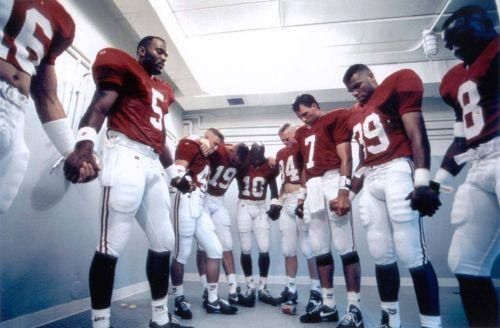
    Alabama Christian Athletes Praying
                Far from being merely a wish list, godly prayer is fundamentally an act of acknowledging God’s sovereignty, confessing our own total reliance on His grace and power, and looking to him as Lord and Provider and Ruler of the universe. God is not some celestial Santa. Any prayers that are self consuming, self indulgent, self aggrandizing; any prayer that seek whatever I want no mater what God wants; any prayer that suggest God must deliver because I have demanded it – those are prayers that take his name in vain. Such praying is egregious sin against the nature of God, against the will of God, and against the Word of God. Because such prayer is an act of worship, to offer a prayer based on such a heinous perversion of God’s character is tantamount to worshiping a false god.

    Source: Pulpit Magazine, Premier Issue. Oct 2012. Vol. 1 No. 1. Ipad version.

    Monday, April 15, 2013

    "Perhaps the Most Christian Human Being"

    by Huffington Post's Jim Wallis

    I just learned about Gordon Cosby who was a prolific and catalytic Southern Baptist pastor in D.C. During the days of segregation in America Cosby's ministry advanced interracial Sundays in D.C. - a practice which would arguably shape the vocations of so many pastors, more than any other figure in his generation (NPR). Cosby is not very famous but this amazing national tribute to his lasting endeavors provides for some really good legacy meditation. I sure hope some of these characteristics can be ascribed of me at my funeral.

    “World War to Spiritual War”
    After he graduated from seminary, the country was entering the war, so Cosby enlisted as a chaplain. Cosby was part of the invasion of Normandy on D-Day. He helped pull wounded soldiers to safety and ministered to the dying. For his service he earned a Silver Star for bravery.

    "At Normandy, he buried hundreds of young men, including his best friend," says Wes Granberg-Michaelson, who knew Cosby for 45 years.

    "As he dealt with young men who were facing death, he realized how poorly equipped they were to deal with the questions of life and death and how poor their faith had prepared them," Granberg-Michaelson says. "And it was that experience that convinced him to — if he survived the war — come back to the states and he would start a church that would have the ability to form faith deeply."

    After his return in 1946, he did just that. The Church of the Saviour was one of the first places of interracial worship in the city. One of the tenets of membership in the church was a commitment to service in the community. Members were required to work with the homeless at shelters and at the church-run hospice and medical clinic.

    “Could have been Famous but the Church was Most Important”
    As his reputation grew, Cosby got invitations to speak from all across the country. He turned them all down; Cosby wanted his church to remain small. "What Gordon understood is that the model of church that he was setting forth — it wasn't going to survive if the church simply got larger and larger and larger," Granberg-Michaelson says. Gordon Cosby never needed or wanted to be out front or become a famous public figure. He could have spoken across the country, and was often invited to do so. But he instead decided that his own vocation was to stay with a relatively small group of people trying to "be the church" in Washington, D.C.: the Church of the Savior, which has produced more missions and ministries, especially with the poor, than any church I know of anywhere in the country -- even the huge mega-churches who capture all the fame. He never wrote a book, went on television, talked to presidents, planted more churches, built national movements, or traveled around the world. He just inspired everybody else to do all those things and much more. And the world came to him.

    “How to live the Gospel and Love like Christ”
    “Gordon Cosby taught us how to live by the Gospel and, in these last years and months, he also showed us how to die,” says Jim Wallis. In one of my many visits near the end of his life, Gordon said to me in his deep graveling voice, "I am enjoying dying." What a Gospel thing to say. From the first time I heard Gordon preach, to the last sermon he did a few years ago, I have never heard the Gospel and its meaning more clearly articulated than from Gordon Cosby. As one person said last night, "You knew he loved like Christ, and he made you want to love like Christ too."

    “Holy Unrest: Thriving After Death”
    Brian McLaren, an author and former evangelical pastor, says that while many evangelical churches don't often survive the death of their founders, Cosby's work is a living testament. "The deeper and broader legacy will be his indirect legacy on the people who were captivated by his holy unrest," McLaren says. "That he just could never be satisfied that the church was fulfilling its potential and that the Christian faith was fulfilling its potential."

    Source:
    1. Huffington Post: http://www.huffingtonpost.com/jim-wallis/gordon-cosby-teaching-us_b_2925125.html?utm_hp_ref=religion
    2. NPR: http://www.npr.org/2013/04/14/177218091/pastor-mentor-and-social-activist-remembering-gordon-cosby

    Saturday, April 13, 2013

    The Power of Worshipful Prayer (Part 2)

    By John MacArthur


    When we properly make our requests known to God – without anxiety,
    through prayer and supplication, and with thanksgiving (Philippians 4:6)
     – we are acknowledging His sovereignty, confessing our own total reliance
    on His grace and power, and looking to Him as Lord and Provider
    and Ruler of the universe – not as some kind of celestial Santa.
    Leading into this next installment on prayer, we are becoming more intimately acquainted with the power and succinctness of prayer through the examinations of John MacArthur. He describes the joy of praying as "the distilled essence of worship." The problem of the misunderstanding of prayer is examined in the first article adopted from Pulpit Magazine's first issue. Particularly examined is how many Christians view prayer as nothing more than "a kind of utilitarian wish list." Unfortunately many stop there and miss out on the unmistakable "parallelism between prayer and worship (5)." This is no coincidence.  Diving deeper we examine how to have closer and lasting fellowship with the Lord God, Jesus, and The Holy Spirit through praying.

    There are several problems with the perspective of prayer as exclusively asking. Prayer is more than merely asking. First, Jesus' model prayer is more than merely "asking." Don't misunderstand, prayer does include asking: there are petitions for daily bread (the bare necessities) and forgiveness (the most urgent of spiritual needs). But the model prayer Jesus gave His disciples also includes at least four of the five elements. There are many who want to eliminate from their definition of prayer: praise, adoration, humiliation, and confession.

    Remove praise and penitence form the Lord's Prayer and you have gutted it. Insist that proper prayer "is not anything else but asking," and you overthrow one of the central lessons we learn from Jesus' example, that prayer is first and foremost an act of worship. Even worse, such teaching sets up a kind of role reversal between the one praying and the God to whom they pray.

    Contrary to what the Bible teaches about our role and bondservant-relationship with the Lord, so-called “Name-it-and-claim-it” theology teaches that man is sovereign and God is his servant. The person praying thinks they are in the demand-and-command position, with God in the role of the servant who is obligated to cough up whatever we ask for. This sort of thinking has more to do with pagan cargo cults than with biblical Christianity.

    Prayer is much more than merely asking and receiving. It is indeed a great privilege to come boldly before the throne of grace and to let our requests be made known to God (Hebrew 4:16; Philippians 4:6).  Scripture repeatedly promises that if we ask for anything in faith, God will answer – meaning if we ask in accord with God’s will as prompted by His Spirit (which we shall commune with actively in daily dialogue), He will always graciously and generously respond, not necessarily give (Matthew 7:7-11; 17:20; 21:22; Mark 11:24; James 1:6; 1John 3:22). He often grants our requests “far more abundantly beyond all that we ask or think, according to the power that works within us (Ephesians 3:20, NASB).


    Godly prayer is fundamentally an act of worship.
    But the nature of a genuine, faithful prayer is clearly spelled out in 1John 5:14: “This is the confidence which we have before Him, that, if we ask anything according to His will, He hears us.” In other words, the promise of answered prayer is not an unqualified blank check. The promise is made only to faithful, obedient, sober-minded, biblically informed Christians whose prayers are in harmony with the will of God. It’s not a guarantee of cargo to every gullible or superstitious religious enthusiast who uses Jesus’ name as an abracadabra. Jesus said, “If you abide in Me, and My words abide in you, ask whatever you wish, and it will be done for you” (John 15:7, emphasis added). The essential element in prayer is tied to Jesus assertion here. Godly prayer is fundamentally an act of worship. It is an expression of our praise, our unworthiness, our desire to see God’s will fulfilled, and our utter dependence on Him for all our needs. Thus every aspect of prayer is an act of worship.

    When we properly make our requests known to God – without anxiety, through prayer and supplication, and with thanksgiving (Philippians 4:6) – we are acknowledging His sovereignty, confessing our own total reliance on His grace and power, and looking to Him as Lord and Provider and Ruler of the universe – not as some kind of celestial Santa. Proper prayer is pure worship, even when we are making requests.

    Source: Pulpit Magazine, Premier Issue. Oct 2012. Vol. 1 No. 1. Ipad version.


    Labels